
Case study
Order Attribution Analytics for WooCommerce
Closing a long-standing gap in WooCommerce, bringing attribution data into the dashboard so merchants can finally see where their sales come from.
Project overview
Order Attribution Analytics began as a proof of concept to close a key gap in WooCommerce's analytics. Many merchants couldn't easily see where their sales were coming from, and we set out to change that. Our goal was to make attribution data simple, accessible, and built into merchants' everyday tools.
Due to time and technical constraints, leadership aligned on using existing legacy components to help us ship quickly. This decision shaped our design direction and allowed us to deliver early value while laying the foundation for future analytics improvements.
Business challenge
WooCommerce merchants have long struggled with understanding the effectiveness of their marketing efforts and sales channels. In conversations with merchants, we repeatedly heard frustration about the lack of visibility into which channels drove their sales.
"I do think that would be beneficial in WooCommerce. If there was more of that kind of data, not just was it direct traffic versus Google or Instagram or something like that."
Merchant interviewThis gap created several pain points. Most merchants lacked the technical expertise to implement and interpret Google Analytics, leaving them unable to make informed marketing decisions. Even when merchants did implement tracking, the data lived outside their WooCommerce dashboard, creating a disjointed experience that required constant context switching.
Merchants also couldn't segment their orders by channel, source, campaign, or device, making it nearly impossible to understand marketing ROI or identify opportunities for optimization. The disconnected nature of their analytics also prevented them from spotting trends over time or comparing performance across initiatives.
We recognized that solving this challenge would deliver substantial value to merchants while positioning WooCommerce more competitively against alternative analytics solutions.
Assumptions
Our approach was shaped by several key assumptions that guided design and implementation:
- Merchants would prioritize ease of use over feature complexity, particularly in early interactions. Our target users weren't analytics experts, they were small business owners who needed clear, actionable insights without a steep learning curve. This led us to focus on simplifying complex data and prioritizing visual clarity over comprehensive density.
- Visual consistency with existing WooCommerce Analytics would improve adoption by leveraging familiar patterns. We also recognized the need to introduce new UI elements where existing components didn't adequately support the required functionality.
- The initial release didn't need to solve every analytics use case. It needed to establish a foundation we could build on. This strategic decision allowed us to deliver value more quickly and set the stage for future enhancements.
Research & discovery
The design process began with thoroughly examining WooCommerce's current order attribution state. While a basic order attribution feature had been added to WooCommerce Core, it only displayed raw data on individual order screens, without aggregation or visualization capabilities.
I collected and analyzed merchant feedback, which consistently highlighted the need for better analytics. One merchant put it well:
"This feature is great, and it would be better if there were a summary analysis for all the order origins."
Merchant feedbackUsing FigJam, I reviewed user interview data and affinity-mapped key themes to identify core pain points. Merchants often shared that current reporting tools lacked context, leaving them guessing what was driving sales. Many expressed frustration that WooCommerce only showed totals without deeper breakdowns. Others described bouncing between WooCommerce and tools like QuickBooks or Google Analytics, which made it difficult to connect marketing activity to actual orders.
These insights confirmed the importance of bringing attribution data directly into the WooCommerce dashboard in a way that felt simple, focused, and immediately useful. To broaden our perspective, I also looked at how other e-commerce platforms and analytics tools approached attribution reporting, surfacing patterns that informed early design direction.
Design exploration
I started by exploring different ways to organize attribution data across multiple dimensions on a single page, sections for channels, sources, campaigns, and devices. We initially considered combining all breakdowns into one report, but early feedback clarified that this approach overwhelmed users.
To reduce cognitive load, I proposed a tab-based layout that separated each attribution view into its own space. This let merchants focus on one lens at a time while maintaining consistency across views.
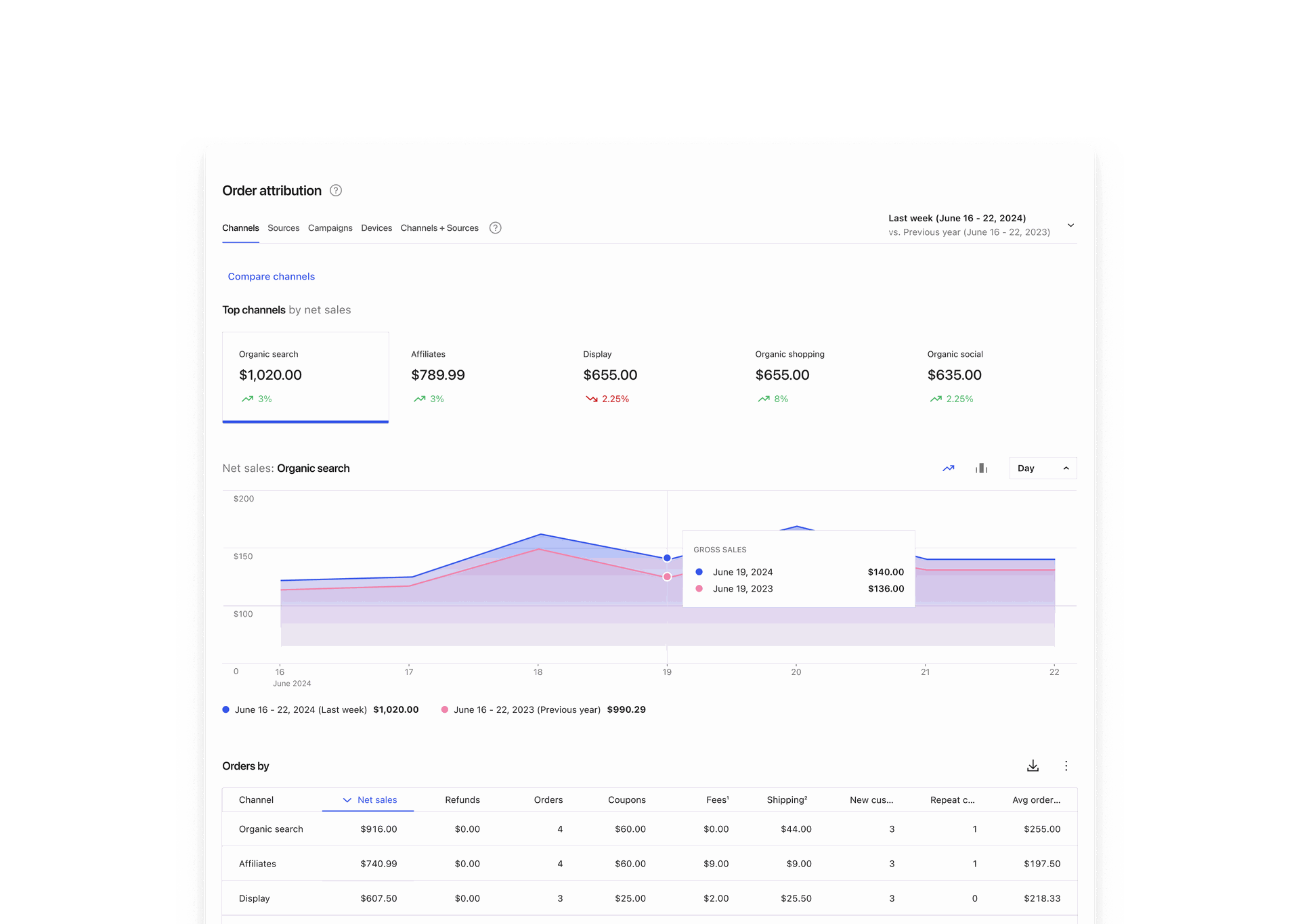
In early prototypes, we included ten metrics by default. During internal reviews it became clear that this created visual noise and made it harder to spot insights. We refined the layout to focus on the top-performing channels by net sales, helping merchants quickly understand what was working without needing to dig.
Another early challenge was working within the visual constraints of the existing WooCommerce Analytics system. Because this project was a proof of concept and needed to ship quickly, we inherited the decision to reuse legacy components. While this limited how far we could push the visual design, I looked for subtle ways to improve the experience without disrupting established patterns.
I shifted the background from gray to white as a small visual cue that this was a new extension and refined the layout for better scanability. I also revisited the chart interaction model. Previously, the chart used a set of checkboxes to toggle different data lines for comparison, a pattern that felt disconnected from the visual context and confused some users. I updated it with a proper legend, where each color corresponded to a specific line, clarifying the visual mapping and aligning with patterns users were familiar with from other reporting tools. I also kept future improvements in mind, like allowing merchants to click a legend item to highlight that line while dimming others.
Throughout this process I worked closely with engineering to ensure our direction was feasible within the existing system. Many ideas had to be shaped by what the platform could support, but rather than fight the constraints, I used them to prioritize simplicity and momentum.
Challenges
One of the biggest challenges was working within a legacy design system while trying to deliver a modern, merchant-friendly experience. We switched between multiple component libraries, including WooCommerce Core, WooCommerce Admin, and System. This made consistency difficult and sometimes led to unexpected behavior. We had to carefully decide when to adapt existing patterns and when to introduce small improvements without breaking compatibility.
Data complexity also created hurdles. Attribution data included a wide range of edge cases, and some orders arrived without clear channel or source labels. We included this unassigned data in most reports to give merchants a more complete picture, while excluding it from views like campaigns where it added little value.
We also ran into issues with the connection and sync flow. Because the feature relied on external services like WordPress.com and Jetpack, merchants sometimes felt confused about the relationship between these platforms. A WooCommerce merchant would click a link and land on a WordPress.com or Jetpack-branded page, raising concerns about whether the experience was broken or unsafe. We flagged this friction and worked to clarify the experience where we could, though some parts were outside our team's immediate scope.
Performance was another concern, especially for high-order stores. Since we couldn't reliably predict how long syncing would take, we focused on respecting the merchant's time. Instead of starting the progress bar at zero, we displayed an estimated midpoint early to help merchants feel that things were already underway. We also explored ways to notify merchants when syncing was complete, so they wouldn't have to sit and wait without knowing when to return.
Results
Order Attribution Analytics is now a live extension in the WooCommerce Marketplace. The project made meaningful impact across several areas:
6,500+
Sites using the extension within months, up from 942 at launch (61% growth)
11–21%
Weekly growth, even without major in-product promotion
97%
Full sync success rate, ensuring a smooth setup for most users
4.2★
Marketplace rating, recovered from initial negative feedback
Adoption grew steadily after launch, confirming a strong product-market fit and clear demand from merchants. The full sync success rate of 97% helped reduce support needs and build confidence in the tool.
From a UX perspective, we transformed raw attribution data into something merchants could use. For the first time, they could see which channels and campaigns were driving sales, directly within the WooCommerce dashboard, making better marketing decisions without relying on external tools or complex technical setups.
Beyond the metrics, this project laid the groundwork for WooCommerce's broader analytics strategy. It showed that merchants want actionable insights, not just raw numbers, and gave our team a working model for delivering value quickly while building toward a more comprehensive analytics offering.
Reflections
This project reminded me that real impact often comes from solving the right problem well, even when the path is messy, the constraints are tight, and the tools aren't ideal.
Working on Order Attribution taught me how to design within a legacy system while still making meaningful improvements. I had to balance technical feasibility with user value, shipping something helpful and straightforward that merchants could use right away. It wasn't about creating the flashiest interface, but about giving merchants clarity at a critical decision point.
I'm proud of how we delivered something helpful, fast, and grounded in real needs. We didn't try to build everything at once, we focused on helping merchants understand where their sales came from and gave them a tool they could rely on. That foundation now supports future analytics improvements.
If I could do it again, I would advocate for even earlier and deeper user involvement. While we validated the problem and got great feedback, some interaction patterns could have benefited from more usability testing before launch.
Most of all, I'm glad I kept merchants at the center of every decision. Even in a fast-paced, constraint-heavy project, that focus helped guide trade-offs and grounded the work.
Credits
This project was made possible through the collaborative efforts of the analytics product and engineering teams, with support from platform and marketing collaborators. Special thanks to everyone who shared feedback, helped shape the solution, and supported the launch.